
Lone tree , Freycinet Peninsula
The Hidden Eastern Coast of Freycinet
Freycinet peninsula holds quiet secrets beyond its famous vistas. Rather than visiting well known lookouts, I prefer hidden places where few venture. Here, towering cliffs drop dramatically into the Tasman Sea, offering endless views toward New Zealand or Antarctica, depending on where you stand. This is rugged coastline full of granite ledges weathered by salt winds. The lone trees clinging to existence at the precipice. An ocean speaking in constant whispers against stone.
The photograph captures this essence: a solitary tree rising from granite, its bare branches reaching skyward as if in conversation with the elements. Below, dark water wraps around ancient rock formations. This is landscape as invitation, not to comprehend but to witness. To stand at the edge and feel what it means to be present in a place that exists so completely beyond ourselves.
Windswept sheoak , Freycinet Peninsula
Photographing from Height: Compositional Challenges
Photographing from sixty meters above sea level presents unique challenges that reshape my approach to composition. At such heights, the horizon dominates. An endless line where ocean meets sky that can easily flatten an image into abstraction. The key is finding foreground anchors that give scale and depth to the vastness below.
In this photograph, a windswept Sheoak tree clings impossibly to the cliff edge, its trunk bent and shaped by years of relentless coastal winds. The tree becomes more than subject. It’s a testament to endurance and survival against the elements. These elements speak of struggle, persistence, and the raw beauty of edges where land surrenders to sea.
Backlit tree on granite cliff, Tasmania
Two Visits, Two Different Perspectives
I visited this coastline weeks ago with a friend, yet returned with entirely different photographs. That first visit carried unspoken pressure to show the place, to cover ground, to capture everything worth seeing. We moved quickly, compositions rushed, attention divided. The result was disconnection. This time, alone, everything shifted. This very spot, a crop of rocks crowned by a windswept tree I had walked past without a second glance before. My mind hadn’t been quiet enough to ask the essential question: what if?
Today, that question led me to photograph directly toward the sun, an unconventional choice that transforms the scene entirely. The backlit sheoak tree pulses with energy, its silhouette revealing strength and confidence against the luminous sky. The granite glows, the distant ocean catches fragments of reflected light, and suddenly the image speaks of something beyond documentation. It captures vitality, grounding, the tree’s unshakeable presence. This is what solitude offers: the space to see what was always there, waiting to be witnessed.
Ocean views from granite rock outcrop, Tasmania
The Whale Song Moment
I am standing on the same location where the previous photograph was made, connected, becoming part of the landscape. Suddenly I hear an unrecognisable sound I’ve never heard before. It’s like a child’s scream echoing across the water. I move closer to the rocky outcrop at the edge and see bellow two unmistakable black shapes breaking the ocean surface. Two humpback whales, resurfacing, and their song fills the air around me. I am filled with gratitude and privilege at witnessing this rare moment, hearing whale song in the nature for the first time.
The photograph of these rocks and distant ocean doesn’t capture the whales as the four minute exposure has smoothed them into the sea’s motion. But the image and whale song is etched in my memory forever. This is why solitude matters in photography.
See short clip I managed to capture with an iPhone:
A rare moment from sixty meters above the Tasman Sea humpback whale surfacing and tail raising before descending into the depths off Freycinet’s coastal cliffs, Tasmania
Dramatic granite cliff and streaming sunlight, Tasmania
Presence and the Photography Process
The practice of presence requires quietening the mind. Releasing preconceived ideas, letting go of familiarity, and approaching each moment without expectation. This photograph emerged from exactly that state. I had been facing the ocean for hours, absorbed in the endless horizon, when something shifted. What if I turned around?
I pivoted, and there it was. A towering granite face catching the sun’s rays, transforming sky into streaming light. The weathered rock formations revealed textures I hadn’t registered before, small plants clinging to impossible ledges, the dramatic sweep of stone meeting air.
This is the camera as navigation tool, guiding me through landscape not by plan but by curiosity. Being in flow means following these impulses without judgment, trusting the journey over the destination. Each frame becomes discovery rather than execution. The details that catch attention through the lens, the way light carves dimension into ancient stone, the delicate life persisting in harsh conditions. These aren’t found by searching. They reveal themselves only when we stop looking for what we expect to find and start seeing what’s actually there.
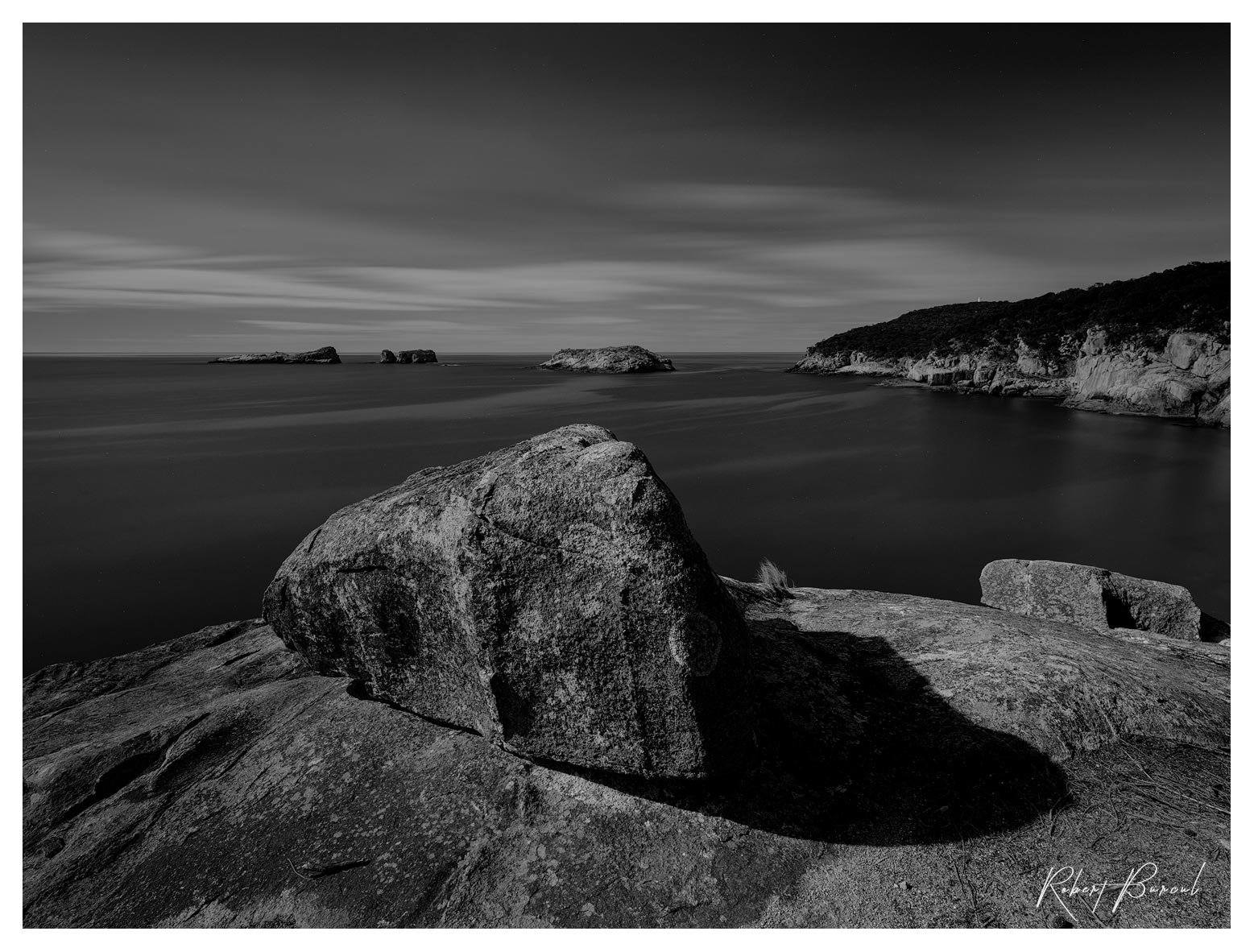
Granite boulder on a cliff edge, Tasmania
The Color vs Black and White Question
Throughout this visit, I wrestled with a familiar tension, photographing in black and white when the location itself screams color. This coastline is covered in vibrant lichen colonies growing on ancient granite rocks. Brilliant reds and oranges that thrive only in Tasmania’s pollution free air. Against the deep blue Tasman Sea, these saturated colors create scenes almost impossible to ignore.
While I’ve selected images that translate powerfully into monochrome for this entry, some landscapes resist it. They need color to tell their complete story. For those curious to experience this place in its full chromatic intensity, I’ve created a Color Gallery that captures what black and white cannot. The vivid, almost unbelievable palette that makes this hidden corner of Freycinet so extraordinary.
For Color images from Freycinet visit :
For Black & White photography visit :