
Photographing dead gum tree on the side of a dirt road in Tasmania’s Central Highlands
Last weekend I returned to the Central Highlands, driving slowly along remote dirt roads, searching for scenes that spark imagination and demand attention. You know that feeling when something catches your eye and you cannot look away without first considering how it would translate through your lens.
These field notes offer practical considerations that might improve your next expedition through Tasmania's high country.
When to Pull Over
When an interesting subject appears, consider slowing down and pulling aside when safe to do so. We often drive past compelling opportunities simply because we keep moving. Great subjects are few and far between.
But here is the critical point: before making any decision to stop, be aware of your surroundings. Never negatively impact other road users' experience or safety. Nothing is more frustrating or dangerous than encountering inconsiderate traveler who suddenly slow down or stop wherever they please, endangering everyone.
Tasmania's landscapes can be breathtaking, but do not be that person who stops in the middle of the road to grab a snapshot. Only stop if it is safe and there is sufficient room on the roadside.
Look in the Rearview Mirror
Sometimes an interesting subject ahead might look far better photographed from the opposite direction. When I travel slowly, I glance in the rearview mirror, watching for vehicles but also considering the reverse view. Often those reversed compositions prove far more interesting.
It is about increasing probability of finding something meaningful. I do not plan what I am going to photograph. I plan to explore the landscape, have conversations with it, discover the subjects within it and the scenery that inspires me in that moment. The same way we work our photography subjects rather than snapping the first frame that comes to mind, we must also work the landscape to arrive at positions where we can see the best possibilities.
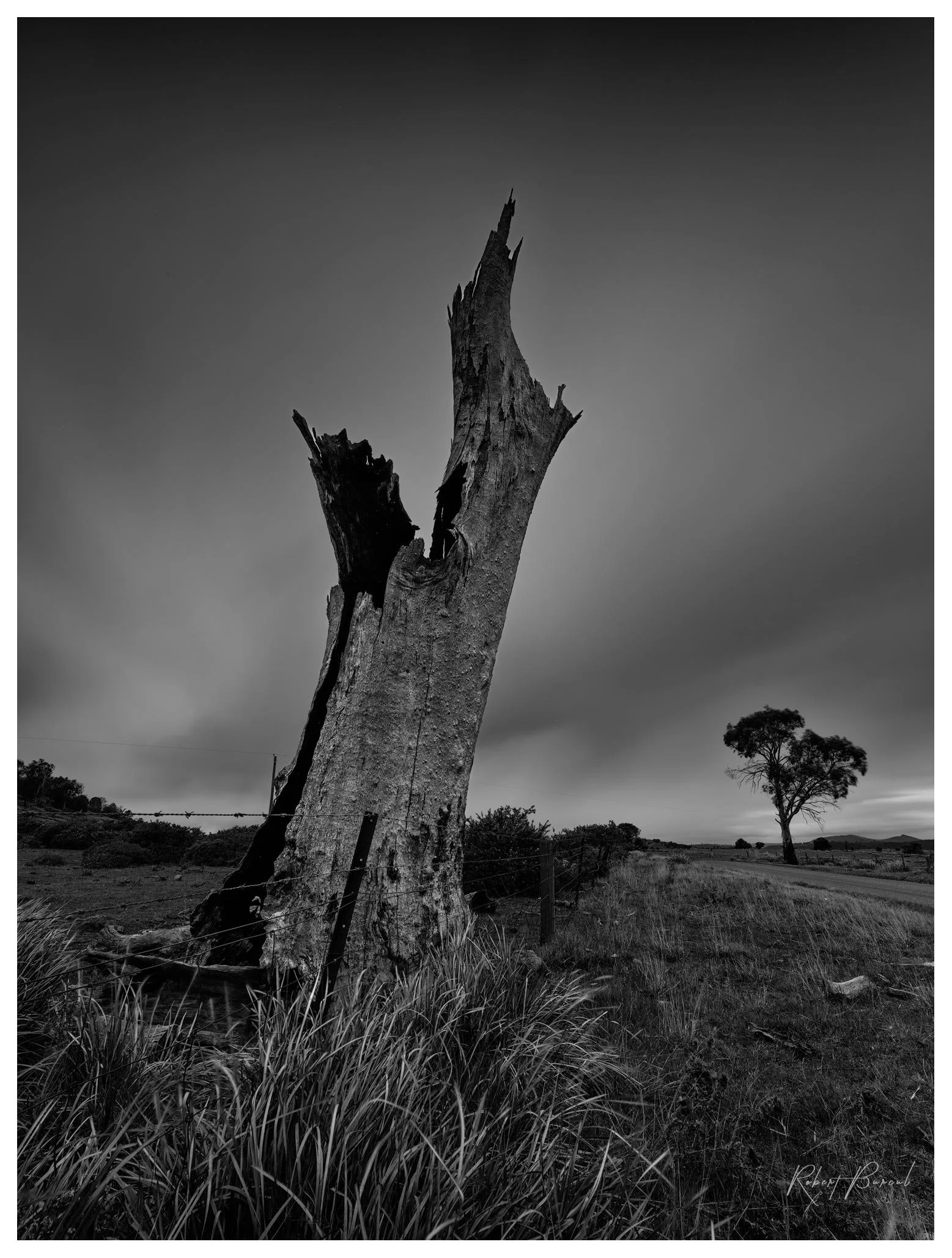
Central Highlands dead gum tree
If it is unsafe to stop at your initial viewing point, continue driving for a kilometer or so, then turn around and approach from the other direction while scanning for those interesting points you have already registered. You might attract the curiosity of local farmers while driving up and down the road, but you are on public roads doing nothing illegal. We are not planning to jump fences to get closer to subjects ( if you do than always ask permission from landowners first), we are only photographing from outside the fence. Often you will discover safer places to pull over this way as well.
I must acknowledge that barbed wire fences seem to be almost everywhere throughout Tasmania. Mostly they exist for good reasons, preventing cattle and other animals from wandering onto roads. However, I share the sentiment and frustration of many landscape photographers when that perfect subject stands just beyond reach.
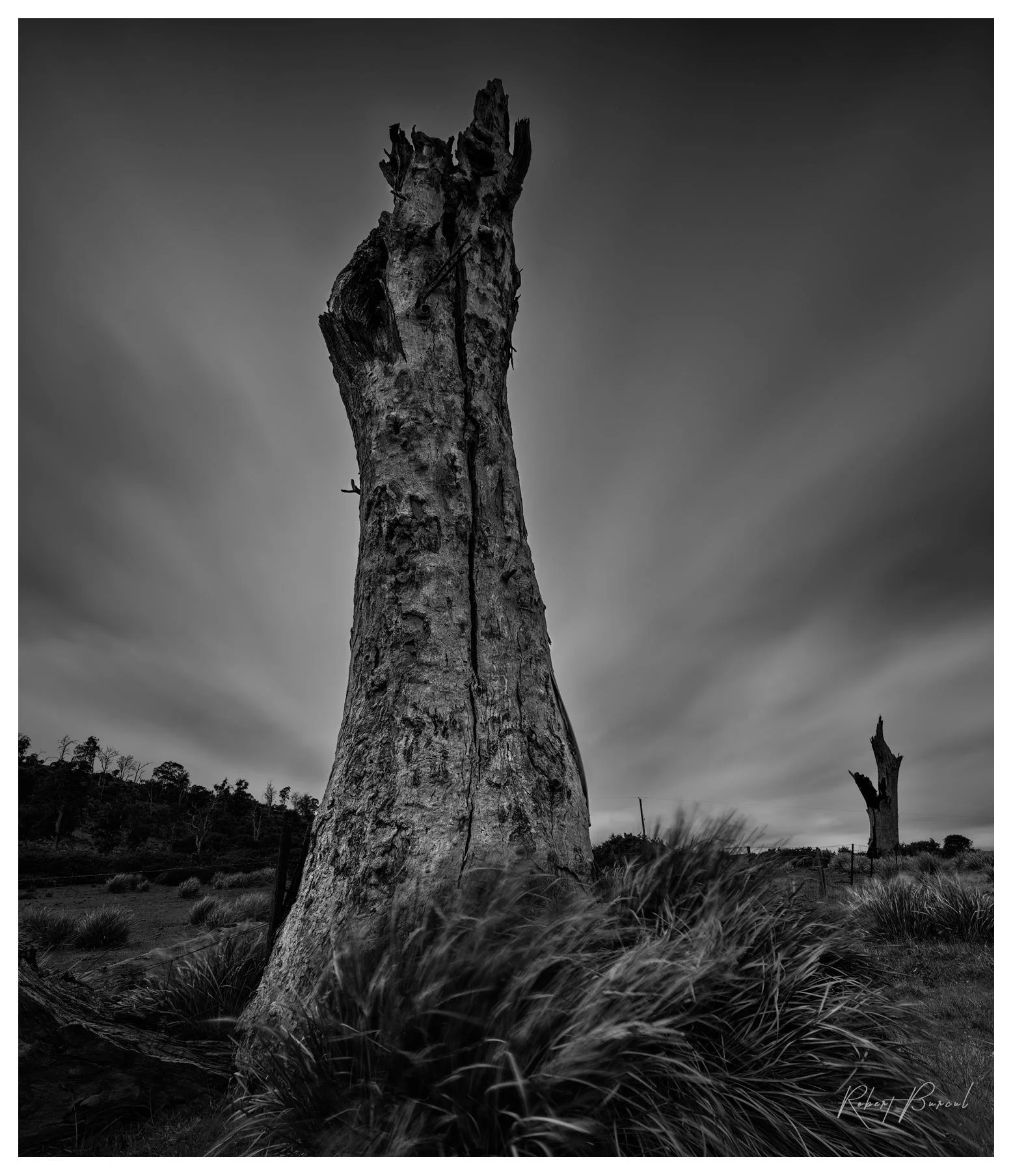
Central Highlands black and white long exposure photography
Working with Long Exposure and Filters
Wind picked up as I worked these skeletal gums. Long exposure transformed grass movement into something ethereal, becoming soft waves flowing around weathered wood.
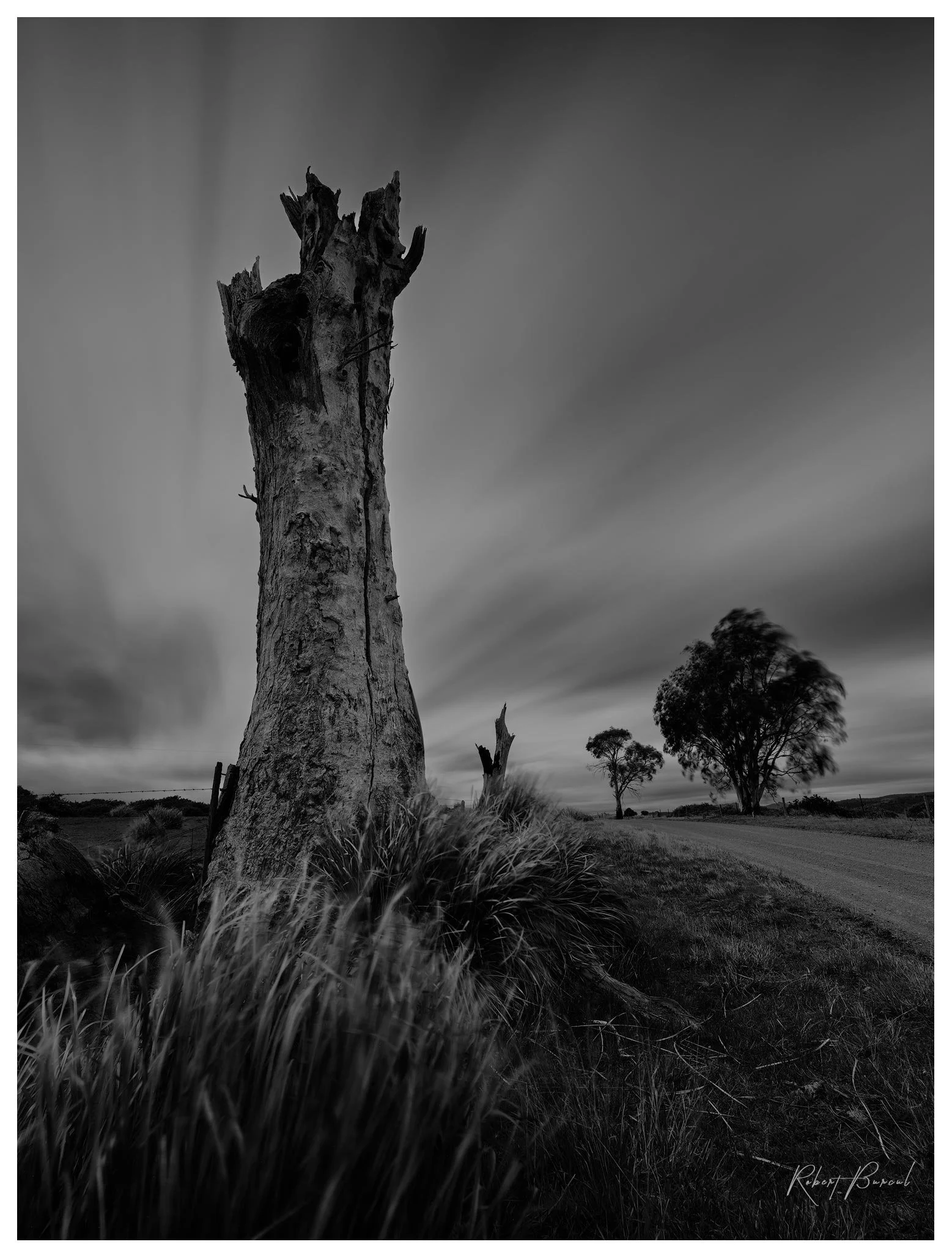
Long exposure black and white landscape photography Tasmania
But using ND filters and graduated filters requires careful consideration. If you are planning to use them, it depends entirely on what effect you are working to achieve. Sometimes using too long an exposure will erase all textures in the sky, or there will be excessive blur from wind moving tree branches and leaves. You must read the conditions and respond accordingly.
Then there is the potential for light leaks. I have lost so many files when I was not considering how the angle of sun impacts all that glass on my lens. When using 10-15 stop NDs, it is crucial to ensure no light leaks occur. I carry a dark cloth to wrap around the lens and filter holder to block stray light. Also check the orientation of your square ND filter within the holder, because you might find some orientations fit better than others regarding sunlight leaks—the foam backing might seal more effectively in one direction depending on your filter model.
Precise focusing becomes an issue when using higher stop NDs. Some photographers prefer to focus first without ND and graduated filters attached to the lens. However, be aware that when NDs and graduated filters are added, the focus point will shift and your focus will be inaccurate. Therefore it is better to focus through all the setup you are planning to use. Using as much magnification as possible on the live view screen and artificially increasing ISO just to achieve focus, or if needed increasing exposure time, all helps to be more accurate.
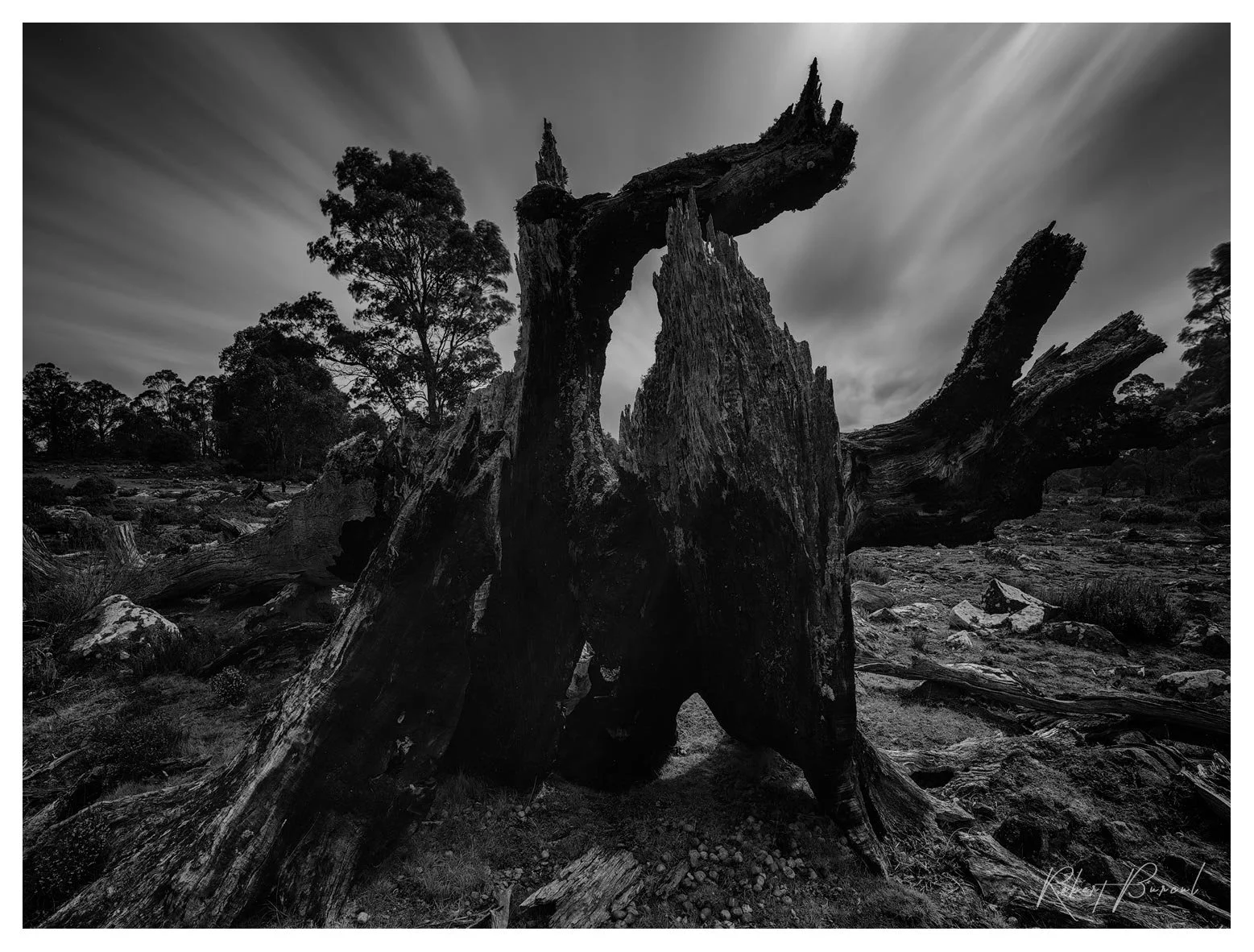
Central Highlands Tasmania landscape in B&W long exposure
A word of caution when using smaller apertures like f/22 to f/32 as this will have downsides. It means your sensor will show every possible speck of dust, requiring tedious cleanup time during editing. I find all my lenses work best between f/11 and f/16. Also, lens diffraction starts to show when smaller f-numbers are used, resulting in loss of sharpness and detail. This largely depends on the quality of optics in your lens.
You might find it useful to have something like a piece of cardboard or small umbrella—if conditions allow—to shelter your camera lens from sun rays during long exposures. When doing four to eight minute exposures, you will find one benefit is having enough time to make a cup of tea. There is no wasted time waiting, and importantly, when slowing down and taking time to compose your long exposures, you will end up with far fewer files and hopefully more quality ones worth spending time editing later.
When Weather Turns
At 820 meters elevation, the high country reminded me of its unpredictable nature. One moment I was working compositions under overcast skies, the next I was engulfed in a sudden snow flurry. The transformation was instantaneous and humbling.
"Sudden snow flurry at 820m elevation in Tasmania's Central Highlands, capturing unpredictable high country weather"
These are the moments that make photographing Tasmania's Central Highlands so compelling—the landscape never allows you to become complacent. Weather systems move through with dramatic speed, transforming light and mood within minutes. This is why preparation matters. Know your equipment well enough to adjust settings quickly when conditions shift. Have your lens cloth ready for snow or rain. Understand your filter system thoroughly so you can respond rather than fumble.
But also embrace these moments. Some of my most memorable experiences in the field have come when weather turned unexpectedly, when the landscape revealed its raw character.
Final Thoughts
These field notes represent one afternoon's work in the Central Highlands, one set of subjects, one conversation with the landscape. Your conversations will be different. The subjects that speak to you will reveal themselves in their own time.
The technical considerations—safe stopping points, filter techniques, focusing methods—these are simply tools to help you respond when those moments arrive. But the real work is slowing down enough to see, being patient enough to wait, being willing to drive that extra kilometer to view your subject from the opposite direction.
The dead gums of Tasmania's high country have stood for decades, weathering storms, enduring seasons. They will still be there next weekend, and the weekend after. Take your time with them. They deserve it.
Explore more monochrome visions from Tasmania's highlands and beyond in my Black and White Galleries